
Will's Teaching Experiences
-
Ithaca College (School of Communications)—Classes Taught
Please click on the links below for more information
Spring 2014
Fall 2013
Spring 2013
Fall 2012
Spring 2012
Fall 2011
-
Indiana University Purdue University Indianapolis (School of Informatics)—Courses Taught
Please click on the links below for more information
Summer 2011
Spring 2011
Fall 2010
-
Indiana University, Bloomington (School of Informatics)—Courses Taught
Please click on the links below for more information
-
Mentorship
Thesis Committee
Master's Thesis: Rory Raabe (Fall 2012-Summer 2013)Project: "Thoughtfully selected: Case study analyses of brick-and-mortar, E-commerce, and blended retailers"Undergraduate Capstone: David Poindexter (Fall 2010-Spring 2011)Project: "Human-Centered Electronic Medical Recording System"Independent Study Supervision
Xiaoyu Dong(Fall 2013)Project: "Learning Standard and Mobile Web Techniques"Preetha Perikkathara(Fall 2013)Project: "Using Twitter to Predict Cinema Success"Undergraduate: Joseph Miller, Oh'n Jay Walker, Jaclyn Duket, and Michael Osborne(Spring 2010)Project: "The Fine Line of Acceptable Behavior: Face to Face vs. Mediated Interaction" PosterUndergraduate: Joseph Miller and Oh'n Jay Walker(Spring 2009)Project: "Conceptualizing Gaming Preferences: Online vs Offline Gameplay"Internship Supervision
Rachael Thaler(Summer 2013)Organization: Washington KastlesAlexis Beebe(Spring 2013)Organization: Project Look Sharp, Cornell UniversityZach Briggs(Summer 2012)Organization: Travers Collins -
Assistant (Indiana University Purdue University Indianapolis, Indianapolis)
INFO 581: Health Informatics Standards and Terms (2 sections)
Spring 2011 with Dr. JT Finnell (Graduate Level Course) -
Graduate Teaching Assistant (Indiana University, Bloomington)
INFO 101: Introduction to Informatics
Fall 2007-Spring 2010 with Matthew Hottell and Nina Onesti (Freshman Level Course)INFO 300: Human-Computer Interaction
Spring 2008, Spring 2009 with Dr. Martin Siegel (Junior-Senior Level Course)INFO 310: Multimedia Arts & Technology
Spring 2006 with Dr. Jeffrey Bardzell (Junior-Senior Level Course)INFO 545: Music Information Representation, Search, and Retrieval
Fall 2005 with Dr. Christopher Raphael (Graduate Level Course)INFO 604: Human-Computer Interaction Design Theory
Fall 2009 with Dr. Erik Stolterman (Graduate Level Course) -
Undergraduate Teaching Assistant (University of Notre Dame)
CSE 211: Fundamentals of Computing I
Fall 2002 with Dr. Matthias Scheutz (Sophomore Level Course)CSE 221: Combinational & Sequential Logic Design
Spring 2003 (Sophomore Level Course)CSE 331: Data Structures
Fall 2003 with Dr. Jesús Izaguirre (Junior Level Course) -
Teaching Based Service
School Service
- Technology Planning Committee 2012-2013
- Curriculum Committee 2011-2013
- IUPUI Informatics Undergraduate Program Committee Member 2010-2011
Department Service
- CMD Communication and Marketing Subcommittee 2011
- Subcommittee to Plan Communication Design Concentration 2011-2012
- Academic Advising:
- Fall 2013, 33 Students
- Spring 2013, 31 Students
- Fall 2012, 35 Students
- Spring 2012, 20 Students
- Fall 2011, 14 Students
Guest Lecture
- STCM 11000 Introduction to Strategic Communication on Mediation 2011-2013
Assessment
- Communication Graduate Program 2011-2012
- CMD Learning Outcomes Subcommittee 2011
Community
- Member of the North Catholic High School Technology Committee for assisting school to develop technology plan 2005, 2008-2009
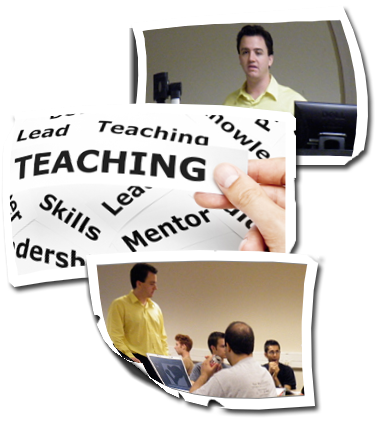
Top: Image of me giving a lecture on Human-Computer Interaction at Indiana University. Middle: Image of teaching and its relationship to other abilities. Bottom: Image of me interacting with students.